
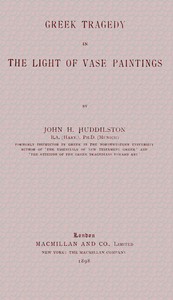
Greek Tragedy in the Light of Vase Paintings by John H. Huddilston
Let's be honest, 'Greek Tragedy in the Light of Vase Paintings' sounds like a dry academic title. But the premise is anything but. John H. Huddilston had a simple, powerful idea: to understand how Greek tragedies were performed, we should stop looking only at the texts and start looking at the art made by the people who watched them.
The Story
This isn't a book with a plot in the traditional sense. Think of it as an investigation. Huddilston acts as a guide, walking us through his theory. He points to specific vase paintings—scenes of mythic heroes, grieving women, and divine interventions—and asks a direct question: Are these just illustrations of the myths, or are they records of specific theatrical moments? He lines up details from the plays of Aeschylus, Sophocles, and Euripides with the poses, costumes, and props shown on the pottery. His goal is to build a bridge between the words we read and the spectacle the ancient audience saw. The 'story' is the journey of connecting these two worlds, piece by painted piece.
Why You Should Read It
This book changed how I see ancient art. Before, I'd walk past a display of Greek vases and admire the craftsmanship. Now, I lean in and look for clues. Is that actor holding a mask? Is that pose a famous moment from a lost play? Huddilston gives you a new lens. His writing is clear and driven by genuine excitement for the puzzle. He doesn't just tell you his conclusions; he shows you the evidence and lets you follow his logic. It makes the ancient theater feel immediate and alive. You start to see those black and red figures not as static art, but as captured fragments of drama, emotion, and movement.
Final Verdict
This is a niche book, but a brilliant one. It's perfect for history buffs, theater fans, or anyone who loves a good historical mystery. You don't need to be a classics professor to get it. If you've ever enjoyed a Greek myth or been curious about ancient culture, Huddilston's detective work is incredibly rewarding. It's for the reader who asks, 'But what did it really look like?' and is willing to explore an unexpected, visually stunning answer. Just be warned: you'll never look at a museum's pottery collection the same way again.
This title is part of the public domain archive. Preserving history for future generations.
Sarah Lee
5 months agoI found the data interpretation to be highly professional and unbiased.
Robert Hernandez
5 months agoI decided to give this a try based on a colleague's recommendation, the historical context mentioned in the early chapters is quite enlightening. I'll be citing this in my upcoming project.
Emily Gonzalez
1 month agoComparing this to other titles in the same genre, the author doesn't just scratch the surface but goes into meaningful detail. I'll be citing this in my upcoming project.
Aiden Wilson
1 year agoAmazing book.






Christopher Johnson
1 year agoI started reading this with a critical mind, the breakdown of complex theories into digestible segments is masterfully done. This is a solid reference for both beginners and experts.