
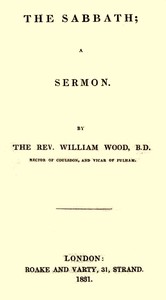
The Sabbath: A Sermon by John Warton
Let's set the scene. It's England in the early 1800s. The Industrial Revolution is picking up speed, and with it comes a new, non-stop rhythm of life. Into this moment steps John Warton, a clergyman. His sermon, published in 1809, isn't a story with characters in the usual sense. The 'character' is society itself, and the 'plot' is Warton's passionate argument against how it's treating Sunday.
The Story
There's no traditional narrative here. Instead, Warton lays out his case like a lawyer before a jury. He points to the Fourth Commandment—"Remember the Sabbath day, to keep it holy"—and then holds up a mirror to his congregation and country. He describes the widespread disregard: farmers working their fields, merchants tallying accounts, travelers journeying, and families using the day for mere leisure or household chores instead of worship and sacred rest. He argues this isn't just a minor slip; it's a collective failure that weakens faith, corrupts public morals, and robs people of a necessary pause. The entire sermon is his attempt to convince his listeners to hit the brakes.
Why You Should Read It
I picked this up expecting a rigid, fire-and-brimstone lecture. What I found was more nuanced. Yes, Warton is uncompromising on the principle of Sabbath observance, but his concern feels genuinely pastoral. You can hear his worry for the overworked laborer who never gets a break, and his frustration with the wealthy who set a bad example. The most fascinating part is how modern his core problem feels. He's describing a society that can't sit still, that sees every day as an economic opportunity. Reading his arguments in our age of side hustles, endless notifications, and glorified burnout is a stark reminder that the struggle for rest is not new. It's a quiet, thoughtful look at the cost of constant doing.
Final Verdict
This isn't for someone looking for a page-turning novel. It's a historical document and a religious argument. But if you're curious about social history, the history of ideas, or even the roots of our own work-life balance debates, this short sermon is a compelling time capsule. It's perfect for history buffs who enjoy primary sources, readers interested in religious thought, or anyone who's ever scrolled through 'hustle culture' posts online and wondered, 'Is this really how we're supposed to live?' Give it an hour of your time. You might be surprised by what a preacher from 1809 has to say about your Sunday.
Legal analysis indicates this work is in the public domain. Thank you for supporting open literature.
Paul Nguyen
2 years agoClear and concise.
Andrew Ramirez
1 year agoA bit long but worth it.
Dorothy Johnson
11 months agoBased on the summary, I decided to read it and the pacing is just right, keeping you engaged. Absolutely essential reading.
Mark Davis
4 months agoI was skeptical at first, but the arguments are well-supported by credible references. Exceeded all my expectations.






Ava Jones
1 year agoGreat reference material for my coursework.