
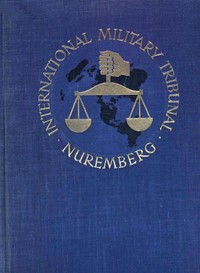
Trial of the Major War Criminals Before the International Military Tribunal,…
Let's be clear from the start: this isn't a book you read for fun. It's a monumental, multi-volume set that contains the official proceedings of the International Military Tribunal in Nuremberg from 1945-1946. It's the courtroom transcript.
The Story
There's no traditional plot. Instead, the 'story' is the legal and moral confrontation itself. The Allies—the US, UK, France, and the Soviet Union—formed this first-of-its-kind court to try the surviving top brass of Nazi Germany for crimes against peace, war crimes, and crimes against humanity. The book presents the prosecution's case, which included mountains of captured documents, films from concentration camps, and survivor testimonies. Then, it gives the floor to the defendants—men like Hermann Göring and Rudolf Hess—and their lawyers. You read their attempts to justify, deflect, or deny. Finally, you get the judges' verdicts and the reasoning behind them. The narrative tension comes from this colossal clash between documented horror and the defenses mounted against it.
Why You Should Read It
I picked this up because I felt like I only knew the 'movie version' of Nuremberg. Reading it was different. It strips away all hindsight and commentary. You're left with the words spoken in that room. It's unsettling to see how bureaucratic and legalistic the language of evil can be, and equally powerful to see the prosecution struggle to build a new concept of justice from the ashes of war. You don't get a narrator telling you who was right or wrong; you witness the arguments and have to sit with them. It made me think deeply about accountability, the rule of law, and how societies can possibly rebuild after something like that. It's not an easy experience, but it's a profoundly important one.
Final Verdict
This is essential reading, but it's for a specific reader. It's perfect for history buffs, law students, or anyone interested in human rights and international justice who wants to go beyond summaries and textbooks. It's not a casual read—some sections are legally dense, and the subject matter is consistently grim. But if you're willing to engage with it, there's nothing else like it. It's the foundational document of modern international criminal law and a stark, primary-source lesson in 20th-century history. Approach it with patience and preparedness, and it will leave a lasting mark on you.
This work has been identified as being free of known copyright restrictions. Thank you for supporting open literature.
Elijah Jones
4 months agoSimply put, the depth of research presented here is truly commendable. I would gladly recommend this title.
Donna Smith
1 year agoGreat reference material for my coursework.
Emily Hernandez
1 year agoBeautifully written.

Karen Rodriguez
1 year agoText is crisp, making it easy to focus.