K
Kaysi
Guest
- Thread Author
- #1
Shirts made with Heat Transfer Vinyl vs. DTF Transfers {HTV vs. DTF}
I love making shirts, it’s one of my favorite things to make. Recently I made shirts for my the local high school music department. I made up 3 different designs for band, for orchestra and for choir. I made up about 150 shirts with heat transfer vinyl. They turned out great but they were a lot of work, so afterwards I decided to look into DTF transfers because they don’t require cutting or weeding. I played with both the heat transfer vinyl and DTF transfers, making the exact same shirt. I thought it would be fun to compare them both and give you my opinion on both HTV and DTF transfers.

Here is a quick video to show the difference between HTV vs. DTF and how to make shirts with each of them.
For both HTV and DTF, I created a design for the shirt.
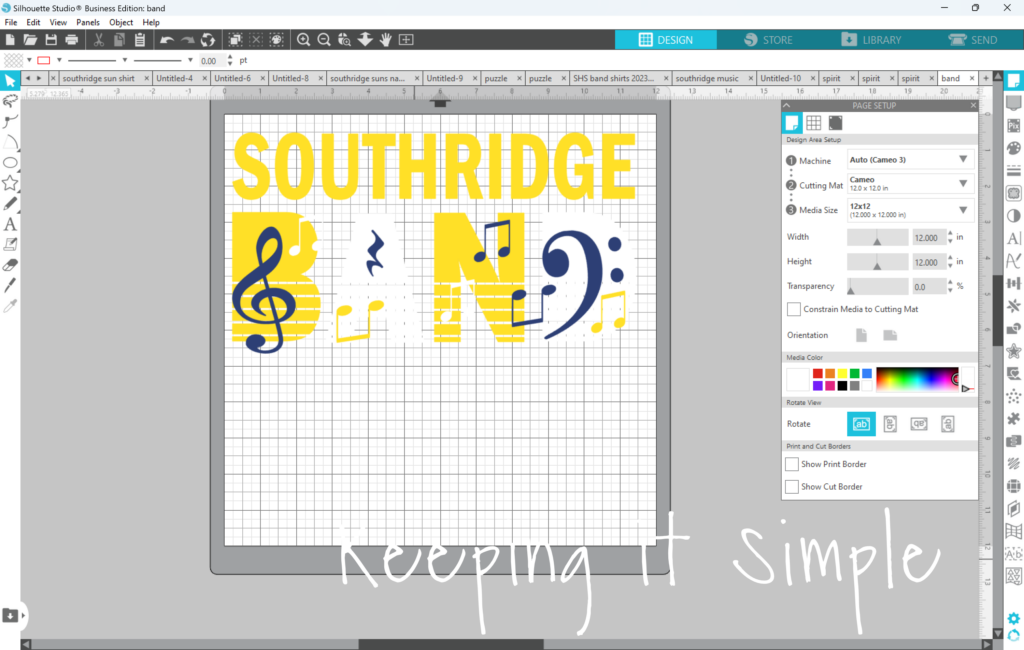
For the HTV, I had to separate the design into the 3 different colors and then I mirrored the design. I then sent the design to the my Silhouette CAMEO to cut it out of the heat transfer vinyl.

Here are the 3 different colors I used for the band shirt. I used the classic EasyWeed HTV in the colors: yellow, navy and white.

I then weeded the vinyl.

Now time for the DTF transfers. The DTF (direct to film) transfers are different than heat transfer vinyl, instead of cutting it out it gets printed out. I used a company to print them out. I turned the Silhouette Studio design into a SVG file and then uploaded on the Jiffy Shirts website. To get free shipping, I did several different designs, but you can do multiple of one design.

Here are the two different transfers: HTV vs DTF.

Now time to put the HTV onto the the shirt. Using a shirt ruler, I positioned the HTV onto the shirt.

Using my heat press, I pressed the yellow layer onto the navy shirt. I pressed it at 305 degrees for 15 seconds and then immediately peeled off the plastic.

I then put the white layer onto the shirt, lining up the lines in the letters. I used a heat press cover sheet to cover the design and then I pressed it again to put the white layer on.

I did the same thing for the navy layer and then the two yellow notes.

And that’s it for the heat transfer vinyl. I love all the different layers and colors of this design. It all looks so good!


Now to put on the DTF transfer. I used the shirt ruler again to line up the design. I used painters tape to keep the design in place so I could put it onto the heat press without it moving.

Using my heat press, I pressed the DTF transfer for 15 seconds on 320 degrees.

Once the plastic was completely cooled down (I waited until 2-3 minutes), I peeled off the plastic.

Then I used the cover sheet again and pressed the design for 5 seconds.

And that’s it for the DTF transfer!

Now let’s compare the two: HTV vs DTF. Each one has it’s pros and each one has it’s cons.
Let’s talk price. For this design, the HTV cost about $2.85 and the DTF cost $1.92.

There are lots of pros about HTV. One majority pro is that you can create shirts without any kind of planning. You can have HTV on hand and create whatever design you would like. It is easier to make a personalize or have a custom shirt with HTV. Another pro is that there are lots of different types of HTV, including glitter and metallic. One con is that you are limited to what colors are available in HTV. Another con is that you have to cut and weed the vinyl, which is time consuming.

The DTF transfers have a lot of pros too. One pro is that they are easy to make, just upload a file and order it and get it shipped to you. No having to cut or weed! Another pro is that you can use lots of different colors and layers and the design will cost the same, it’s just based on the square footage. Another pro is that everything is already lined up and you don’t have to worry about lining up the layers. One major con for me is that even though it looks good, it still looks like it printed, the colors aren’t solid. The DTF transfer print onto a white base, so the dark colors have a white line around them. Another con is that the lines aren’t as crisp as the HTV. Another con is that you have to plan ahead with the DTF transfers. Since I don’t have a huge DTF printer, I have to order them and that takes time and planning. Which is not always convenient or practical.

There are pros and cons to both the HTV and DTF transfers. A lot of it has to go to preference and what exactly you are creating. If you are creating something with a lot of layers and colors, DTF might be better. If you are creating something that is simple or you want to be unique, then HTV might be better. Either way, both HTV and DTF make amazing shirts and I know that I will be using both.

Check out all of the other shirts I have made through out the years!
I love making shirts, it’s one of my favorite things to make. Recently I made shirts for my the local high school music department. I made up 3 different designs for band, for orchestra and for choir. I made up about 150 shirts with heat transfer vinyl. They turned out great but they were a lot of work, so afterwards I decided to look into DTF transfers because they don’t require cutting or weeding. I played with both the heat transfer vinyl and DTF transfers, making the exact same shirt. I thought it would be fun to compare them both and give you my opinion on both HTV and DTF transfers.
Here is a quick video to show the difference between HTV vs. DTF and how to make shirts with each of them.
For both HTV and DTF, I created a design for the shirt.
For the HTV, I had to separate the design into the 3 different colors and then I mirrored the design. I then sent the design to the my Silhouette CAMEO to cut it out of the heat transfer vinyl.
Here are the 3 different colors I used for the band shirt. I used the classic EasyWeed HTV in the colors: yellow, navy and white.
I then weeded the vinyl.
Now time for the DTF transfers. The DTF (direct to film) transfers are different than heat transfer vinyl, instead of cutting it out it gets printed out. I used a company to print them out. I turned the Silhouette Studio design into a SVG file and then uploaded on the Jiffy Shirts website. To get free shipping, I did several different designs, but you can do multiple of one design.
Here are the two different transfers: HTV vs DTF.
Now time to put the HTV onto the the shirt. Using a shirt ruler, I positioned the HTV onto the shirt.
Using my heat press, I pressed the yellow layer onto the navy shirt. I pressed it at 305 degrees for 15 seconds and then immediately peeled off the plastic.
I then put the white layer onto the shirt, lining up the lines in the letters. I used a heat press cover sheet to cover the design and then I pressed it again to put the white layer on.
I did the same thing for the navy layer and then the two yellow notes.
And that’s it for the heat transfer vinyl. I love all the different layers and colors of this design. It all looks so good!
Now to put on the DTF transfer. I used the shirt ruler again to line up the design. I used painters tape to keep the design in place so I could put it onto the heat press without it moving.
Using my heat press, I pressed the DTF transfer for 15 seconds on 320 degrees.
Once the plastic was completely cooled down (I waited until 2-3 minutes), I peeled off the plastic.
Then I used the cover sheet again and pressed the design for 5 seconds.
And that’s it for the DTF transfer!
Now let’s compare the two: HTV vs DTF. Each one has it’s pros and each one has it’s cons.
Let’s talk price. For this design, the HTV cost about $2.85 and the DTF cost $1.92.
There are lots of pros about HTV. One majority pro is that you can create shirts without any kind of planning. You can have HTV on hand and create whatever design you would like. It is easier to make a personalize or have a custom shirt with HTV. Another pro is that there are lots of different types of HTV, including glitter and metallic. One con is that you are limited to what colors are available in HTV. Another con is that you have to cut and weed the vinyl, which is time consuming.
The DTF transfers have a lot of pros too. One pro is that they are easy to make, just upload a file and order it and get it shipped to you. No having to cut or weed! Another pro is that you can use lots of different colors and layers and the design will cost the same, it’s just based on the square footage. Another pro is that everything is already lined up and you don’t have to worry about lining up the layers. One major con for me is that even though it looks good, it still looks like it printed, the colors aren’t solid. The DTF transfer print onto a white base, so the dark colors have a white line around them. Another con is that the lines aren’t as crisp as the HTV. Another con is that you have to plan ahead with the DTF transfers. Since I don’t have a huge DTF printer, I have to order them and that takes time and planning. Which is not always convenient or practical.
There are pros and cons to both the HTV and DTF transfers. A lot of it has to go to preference and what exactly you are creating. If you are creating something with a lot of layers and colors, DTF might be better. If you are creating something that is simple or you want to be unique, then HTV might be better. Either way, both HTV and DTF make amazing shirts and I know that I will be using both.
Check out all of the other shirts I have made through out the years!
This post contains affiliate links.
The post Shirts made with Heat Transfer Vinyl vs. DTF Transfers {HTV vs. DTF} first appeared on Keeping it Simple.