About 324 minutes
Katie Robertson — A Reader’s Guide
Exploration Survival Adventure Tales
74,426 recorded words. 31 minutes difference from this book's estimate.
View Gutenberg source #23795
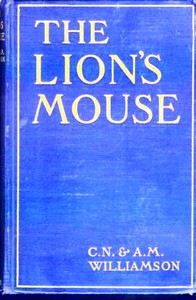
The catalog record for The Lion's Mouse — Story, Setting & Ideas provides practical reading context through 81,639 words, 5 hr 55 min estimated reading time, and 8 detected text sections.
The text analysis averages about 12.5 words per sentence, while the detected sections provide another way to judge how the source is divided.
Project Gutenberg metadata also associates the work with “Adventure stories,” connecting these edition facts with the source record’s subject description.
Explore this collection
These alternatives are selected using recorded categories and estimated reading time.
About 324 minutes
Exploration Survival Adventure Tales
74,426 recorded words. 31 minutes difference from this book's estimate.
View Gutenberg source #23795About 295 minutes
Exploration Survival Adventure Tales
67,642 recorded words. 60 minutes difference from this book's estimate.
View Gutenberg source #21466About 282 minutes
Exploration Survival Adventure Tales
64,674 recorded words. 73 minutes difference from this book's estimate.
View Gutenberg source #24297Search stored excerpts and compare books → Choose by your preferences →
Choices use stored catalog measurements. Estimates vary with reading speed. A shared category is a catalog label, not a claim that two books have the same argument or literary quality.
Search reads excerpt text stored with this catalog and links to its associated Gutenberg record. The connection is stored in the site database; this tool does not recheck that every excerpt is word-for-word identical to that external record. Excerpt search does not cover every chapter and does not verify historical publication dates.
Catalog snapshot checked: 2026-09-26. Coverage: 94 public books, 94 available source excerpts.
Calculated from edition completeness, EPUB availability, text structure and catalogue metadata. Not a user rating.
Total of 100 points, scaled to a 2.5-5.0 range. Editions with an empty description or a missing EPUB file are not scored.
Public-domain source text
The source text is kept in the dedicated reader, separate from this catalogue record and its commentary.
The novel opens aboard the Santa Fé Limited, where Roger Sands, a man who prides himself on being 'hard as nails,' is drawn into a stranger's plea for help. The confined setting of a train stateroom becomes the first of many enclosed spaces—hotel rooms, boudoirs, telephone booths—that structure the story. The authors use these tight quarters to generate tension, as characters eavesdrop, hide, and improvise under pressure. The opening scene establishes a pattern: a woman appears at a threshold, a door closes, and a secret transaction begins.
The narrative repeatedly hinges on doors left open or closed. Roger's stateroom door is open when the woman appears; later, Clo listens at a telephone while a door to a chest of drawers yields a hidden pearl. The threshold between public and private space is constantly crossed. In the excerpt, Clo 'thrusting her arm underneath' a chest of drawers retrieves a pearl 'lodged against the wall at the back'—a small object that shifts the plot. The authors use these physical boundaries to mark moments of decision: entering a room, shutting a door, or letting a receiver hang loose.
The telephone scene in the excerpt is a set piece of misdirection. Clo impersonates a woman named Kit, improvising answers to a foreign-sounding caller. The conversation reveals key facts—a time limit of ten o'clock, a demand for 'the real docs,' and a theft of pearls—but only in fragments. The authors structure the dialogue so that Clo must 'hedge' and 'think' between responses, turning the phone into a stage for quick thinking. The receiver 'hanging loose' becomes a symbol of suspended truth, and the call itself a mechanism for the reader to piece together events alongside the protagonist.
Small, tangible items drive the plot forward. The pearl Clo finds 'about the size of a small filbert' is a physical clue that Peterson is the thief. Earlier, a 'parcel with the gold seals' and 'the Queen's pearls' are listed in the chapter titles as pivotal objects. The authors treat these items as evidence that characters must interpret—Clo examines the pearl, deduces its origin, and uses it to test the caller. The narrative does not explain the objects' full significance immediately; instead, it lets them accumulate meaning through repeated appearances and characters' reactions.
The story moves rapidly from train to hotel to apartment, each location a contained stage. The excerpt shifts from a stateroom to a 'dirty carpet' under a chest of drawers, then back to the telephone. The chapter titles suggest a journey: 'On the Way to the Car,' 'The Stone Coping,' 'On the Road to Newport.' This constant movement between rooms and vehicles creates a rhythm of pursuit and retreat. Characters are often caught between places—hovering at doors, waiting for calls, packing suitcases. The authors use these transitions to heighten uncertainty, as no setting offers permanent safety.
Readers should attend to the way the authors build suspense through incomplete information. The excerpts show that key revelations come through overheard dialogue and discovered objects, not direct narration. The structure rewards careful attention to what is left unsaid—the gaps in phone conversations, the objects hidden in corners. The novel's title hints at a power imbalance, but the excerpts suggest that the 'mouse' may be more resourceful than the 'lion' expects.
I found myself thinking about the last time I sat on a train, watching someone’s story unfold just beyond my window. This book’s quiet tension reminded me of my own old paperback copy of In the Rocky Mountains — Story, Setting & Ideas. They share that same raw, uncertain feeling—an unspoken turn waiting just ahead, a brief moment holding its breath.
Create a short personal record of your experience with this book.