About 282 minutes
The River of Darkness; Or, Under Africa — Inside the Classic
Exploration Survival Adventure Tales
64,674 recorded words. 57 minutes difference from this book's estimate.
View Gutenberg source #24297
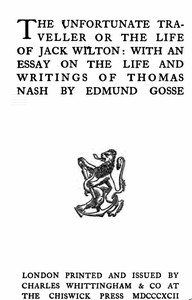
This digital edition of The Vnfortunate Traveller, or The Life of Jack Wilton With an Essay on the Life and Writings of Thomas Nash by Edmund Gosse — Text and Context is described by source-level measurements including 51,709 words, 3 hr 45 min estimated reading time, and 6 detected text sections.
The text analysis averages about 32.7 words per sentence, while the detected sections provide another way to judge how the source is divided.
Project Gutenberg metadata also associates the work with “Adventure stories,” connecting these edition facts with the source record’s subject description.
Explore this collection
These alternatives are selected using recorded categories and estimated reading time.
About 282 minutes
Exploration Survival Adventure Tales
64,674 recorded words. 57 minutes difference from this book's estimate.
View Gutenberg source #24297About 295 minutes
Exploration Survival Adventure Tales
67,642 recorded words. 70 minutes difference from this book's estimate.
View Gutenberg source #21466About 146 minutes
Exploration Survival Adventure Tales
33,382 recorded words. 79 minutes difference from this book's estimate.
View Gutenberg source #21850Search stored excerpts and compare books → Choose by your preferences →
Choices use stored catalog measurements. Estimates vary with reading speed. A shared category is a catalog label, not a claim that two books have the same argument or literary quality.
Search reads excerpt text stored with this catalog and links to its associated Gutenberg record. The connection is stored in the site database; this tool does not recheck that every excerpt is word-for-word identical to that external record. Excerpt search does not cover every chapter and does not verify historical publication dates.
Catalog snapshot checked: 2026-09-26. Coverage: 94 public books, 94 available source excerpts.
Calculated from edition completeness, EPUB availability, text structure and catalogue metadata. Not a user rating.
Total of 100 points, scaled to a 2.5-5.0 range. Editions with an empty description or a missing EPUB file are not scored.
Public-domain source text
The source text is kept in the dedicated reader, separate from this catalogue record and its commentary.
Edmund Gosse's introductory essay, written for the 1892 Chiswick Press edition, presents Thomas Nash as a writer of 'extreme rarity' whose works 'may probably be counted on the fingers of two hands.' This framing is at odds with the catalog subjects of 'Adventure stories' and 'Travelers -- Fiction,' which suggest a straightforward picaresque. The excerpts from Nash's novel, however, show a narrator, Jack Wilton, whose voice is anything but simple: he describes a woman's skin 'as slike and soft as the backe of a swan' and a husband 'too vertuous to make her vicious.' The text is dense with rhetorical flourishes, classical allusions, and a self-conscious playfulness that complicates any easy classification as mere adventure.
Gosse's essay treats Nash as an antiquarian curiosity, emphasizing the 'extreme rarity' of his works and the fact that 'three centuries of readers have existed cheerfully' without him. Yet the excerpts from The Unfortunate Traveller pulse with energetic, idiosyncratic language. Jack Wilton's description of a woman—'a skin as slike and soft as the backe of a swan'—and his claim that 'Golde easily bends, the most ingenious mindes are easiest moued' reveal a writer who delights in metaphor and aphorism. Gosse's scholarly tone, with its measured judgments about Nash's 'relative if not positive' merits, stands in stark contrast to the novel's playful, irreverent voice. The reader encounters two distinct registers: the editor's retrospective assessment and the original text's vibrant, sometimes bawdy, Elizabethan energy.
Jack Wilton, the narrator, is a page who openly admits to 'pawning the credit of a page' and describes his master's courtly antics with a mixture of mockery and admiration. In one passage, the master 'would kneele and kisse the ground as holy grounde' while imagining his mistress as Geraldine, a figure from Surrey's poetry. Wilton observes that his master 'was more in loue with his owne curious forming fancie than her face,' undercutting the romantic pose. This self-aware narration—where the page comments on the performance of love—suggests that the novel is as much about storytelling and deception as about travel. The catalog subject 'Adventure stories' may mislead: the excerpts focus less on external action than on the narrator's witty observations and the theatricality of desire.
The excerpts place the characters in a prison, where the page and his master encounter a 'Magnificos wife' described as 'immaculate honest till she met with vs in prison.' The setting is not an exotic foreign land but a confined, hierarchical space where social roles are tested. The wife's chastity is questioned not through travel but through proximity to the page's 'temptations.' This indoor, claustrophobic environment contrasts with the expansive 'traveler' label. Nash's prose dwells on the wife's appearance—'a sharpe nose, as fat and plum euerie part of her as a plouer'—and her moral ambiguity, suggesting that the 'adventure' here is psychological and social rather than geographical. The catalog's 'Travelers -- Fiction' category may obscure the novel's interest in stasis and confinement.
Readers approaching this edition should be prepared for a work that resists easy generic classification. Gosse's essay provides historical context but may overstate Nash's obscurity; the novel itself is lively, dense, and metafictional. Pay attention to the narrator's ironic asides and the way he frames his own tale—these are the true 'adventures' of the text. The juxtaposition of Gosse's scholarly apparatus with Nash's playful prose creates a layered reading experience that rewards careful attention to both voices.
Jack Wilton’s gilded cage of wit always felt like a quiet companion to another lonely voice—Edward’s restless wandering in Rattlin the Reefer — Text and Context shares that same imprisoned restlessness, though one wears satire, the other salt-spray. I have shelved them side by side for years, each whispering of clever men trapped by their own skins.
Build a private reading journal entry for this title.