About 90 minutes
Hatty and Marcus or, First Steps in the Better Path — Reading Notes
Fantasy Juvenile Worlds
20,494 recorded words. 12 minutes difference from this book's estimate.
View Gutenberg source #23536
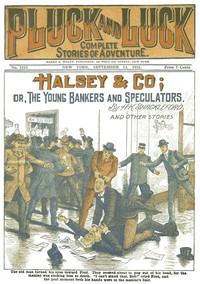
The source record for Halsey & Co. or, The Young Bankers and Speculators — Reading Companion measures this digital text at 23,373 words, 1 hr 42 min estimated reading time, and 16 detected text sections.
The text analysis averages about 12.3 words per sentence, while the detected sections provide another way to judge how the source is divided.
Project Gutenberg metadata also associates the work with “Boys -- Juvenile fiction,” connecting these edition facts with the source record’s subject description.
Explore this collection
These alternatives are selected using recorded categories and estimated reading time.
About 90 minutes
Fantasy Juvenile Worlds
20,494 recorded words. 12 minutes difference from this book's estimate.
View Gutenberg source #23536About 43 minutes
Fantasy Juvenile Worlds
9,890 recorded words. 59 minutes difference from this book's estimate.
View Gutenberg source #23030About 42 minutes
Fantasy Juvenile Worlds
9,511 recorded words. 60 minutes difference from this book's estimate.
View Gutenberg source #23699Search stored excerpts and compare books → Choose by your preferences →
Choices use stored catalog measurements. Estimates vary with reading speed. A shared category is a catalog label, not a claim that two books have the same argument or literary quality.
Search reads excerpt text stored with this catalog and links to its associated Gutenberg record. The connection is stored in the site database; this tool does not recheck that every excerpt is word-for-word identical to that external record. Excerpt search does not cover every chapter and does not verify historical publication dates.
Catalog snapshot checked: 2026-09-26. Coverage: 94 public books, 94 available source excerpts.
Calculated from edition completeness, EPUB availability, text structure and catalogue metadata. Not a user rating.
Total of 100 points, scaled to a 2.5-5.0 range. Editions with an empty description or a missing EPUB file are not scored.
Public-domain source text
The source text is kept in the dedicated reader, separate from this catalogue record and its commentary.
The novel opens not with a boy's adventure but with a banker's private office and a newsboy's urgent warning: 'There's a couple of men putting up a big job on your bank.' Fred Halsey, a daily paper carrier, has overheard a forged-check scheme and insists on being heard. The banker, Mr. Barron, responds with cool pragmatism, instructing his detective to let the forgers complete the transaction 'so as to make a good case against him.' The scene establishes a tone of street-smart vigilance and institutional caution, with Fred's confidence—'I am not afraid of anybody'—pitted against the banker's measured trust. The language is direct, the pacing brisk, and the setting firmly anchored in the financial district's public halls and cashier windows.
Fred Halsey's voice shifts markedly across the excerpts. In the opening chapter, he speaks with the clipped urgency of a boy who has learned to navigate adult spaces: 'The bouncer told me to go away, sir, but I knew my business better than he does.' His syntax is plain, his confidence unadorned. Later, as a partner in Halsey & Company, his speech acquires a harder edge. When discussing Wall Street ethics with the older cashier Allison, Fred declares: 'Business knows no friendship. It is merciless in its operations.' Allison is 'almost startled' by such cynicism from one so young. Fred attributes this view to his time as a messenger boy in the Stock Exchange, where he 'got the idea from what I saw going on all around me.' The novel thus traces a linguistic arc from boyish directness to a learned, almost jaded commercial voice, without ever losing the vernacular rhythms of the street.
The narrative alternates between two distinct tempos. The forgery plot unfolds in near-real time: 'More than an hour passed, and still they stood there on the watch.' The prose slows to match the detective's patient surveillance, then accelerates with Fred's sudden nudge—'nudged him good'—and the identification of the man 'in the gray ulster.' Later, the pace shifts to the quick exchanges of the banking office. Dialogue becomes staccato, crowded with interruptions: 'Say, give us a loan, Bob.' 'Cash a check for me, Fred.' 'How much chink have you got, boys?' The welkin rings with shouts, and Fred's response—'Come by to-morrow at this time and get a ticket for a square meal'—dismisses the crowd with practiced efficiency. This alternation between tense stillness and bustling commerce gives the novel a rhythm that mirrors the trading floor's own cycles of lull and frenzy.
The excerpts repeatedly anchor action in specific locations: the banker's private office, the public hall of the bank, the cashier's window, and later the 'big plate glass front' of Halsey & Company. These are not backdrops but active spaces that shape behavior. The bank's layout—private office, outer office, public hall—creates a hierarchy of access that Fred must breach. The Stock Exchange is invoked as a school: 'Where did you pick up that idea?' Allison asks. 'In the Stock Exchange when I was a messenger boy.' The street itself is a source of knowledge, as when Allison reveals that a seemingly destitute beggar 'has ten thousand dollars in bank and owns real estate somewhere on Manhattan island.' Fred's incredulity—'Well, I'll be hanged!'—underscores how the setting continually revises his understanding of the financial world. Wall Street is not just a place but a teacher, and its lessons are delivered through overheard talk, observed transactions, and the constant press of messengers, boothblacks, and newsboys.
Readers attentive to language will note how Shackleford uses dialogue to convey information without exposition: the forged-check plot is revealed entirely through Fred's report, and the bank's operations emerge through banter. The novel's brevity—under 24,000 words—means each scene carries weight. Pay particular attention to the moments when Fred's voice hardens, as these mark the story's quiet argument about what the Street teaches its youngest participants. The excerpts offer only a partial view of the complete book, but they suggest a work more interested in the mechanics of finance and the education of a young speculator than in conventional juvenile adventure.
Rain hammered the windows that afternoon while young Fred Halsey traded paper fortunes in a world of sharp edges and sharper trust. His cynicism stayed with me, oddly comforting. Later, I found myself wandering into gentler pages, where a tailor in Dalkeith measured character by the yard. Both understood that money merely exposes what we already are. Here is The Life of Mansie Wauch tailor in Dalkeith — Key Ideas to Explore, a quieter mirror of the same old truth.
A brief reflection can help important ideas stay with you longer.